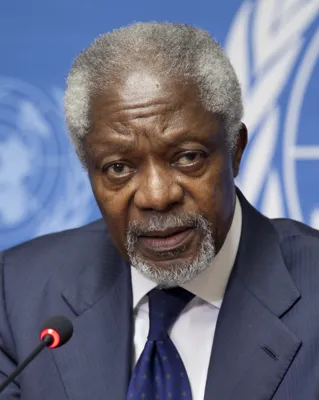

When Kofi Annan died in August 2018, Ghana lost the only African to have served as Secretary-General of the United Nations and the man who, for a decade at the head of the world's most complex multilateral institution, carried the country's name into every room where the world's most consequential decisions were made. His life was an argument, made through example, that leadership rooted in humanity could be more effective than power exercised through force.
The making of a diplomat
Kofi Atta Annan was born on 8 April 1938 in Kumasi, into the Fante and Asante aristocracy: his father, Henry Reginald Annan, was both a provincial governor and a chief of the Fante people, and his maternal grandfather and his uncle were paramount chiefs. He was educated at the University of Science and Technology in Kumasi, then at Macalester College in Minnesota in the United States, where he completed his undergraduate degree in economics in 1961. Graduate studies at the Institut universitaire des hautes etudes internationales in Geneva and the MIT Sloan School of Management gave him the academic formation that a long international career would require.
Rise through the UN
Annan joined the United Nations in 1962 as a budget officer with the World Health Organization, beginning an ascent through the UN system that would take him to positions covering peacekeeping, refugee affairs and administration. His appointment as Head of UN Peacekeeping in 1993 placed him at the centre of two of the 1990s' most traumatic episodes: the Rwandan genocide, during which the UN's failure to intervene has haunted him and the institution, and the war in Bosnia. The experience shaped his subsequent emphasis on the Responsibility to Protect doctrine, which he championed as Secretary-General.
Secretary-General: ten years at the top
Annan became UN Secretary-General on 1 January 1997, the first to rise from within the institution's professional staff. He served two five-year terms, presiding over the UN through the tumultuous decade that included the US-led invasion of Iraq, the establishment of the International Criminal Court, and the adoption of the Millennium Development Goals. In 2001, he and the United Nations were jointly awarded the Nobel Peace Prize, the citation noting his bringing new life to the organisation and prioritising the fight for human rights globally. His relationship with the United States became strained over Iraq, where he publicly opposed the invasion, and he left the post in 2006 having both enlarged the UN's ambitions and been damaged by the Oil-for-Food scandal.
Legacy
Kofi Annan's legacy is complex in the way that the legacies of those who wield real power at the highest level always are: both the Rwanda and Iraq failures belong to him, and so does a decade of effort to make the UN more capable of protecting the people it exists to serve. What is not in dispute is that he was the right person for that era, a leader whose manner inspired trust at a time when the UN desperately needed it, and whose Ghanaian upbringing gave him a perspective on the world that the powerful nations who fund the institution could not themselves have provided.