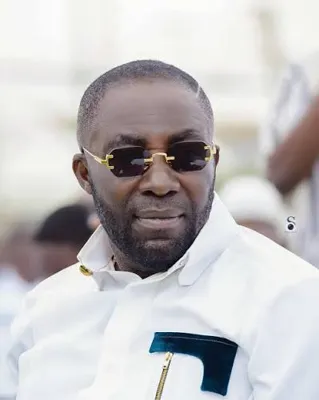

Ghana does not have a long list of confirmed billionaires by global standards. But the wealth that exists at the top of the country’s economy was built through businesses that are woven into Ghanaian daily life in ways that foreign-listed corporations rarely are. When a Ghanaian buys a sachet of water, watches an afternoon talk show, or flies through a private terminal at Kotoka International Airport, they are interacting with empires that were built from scratch over the past three to four decades.
Daniel McKorley: From Kerosene to the Sky
Daniel McKorley, known widely as McDan, is the closest thing Ghana has to a self-made billionaire in the conventional sense. His estimated net worth of around one billion US dollars comes from a business empire that spans shipping, oil and gas, construction, and aviation. He founded McDan Group in the early 1990s, starting with a small trading operation that included selling kerosene, and expanded into industries that required patience, capital, and political relationships to navigate.
His most visible asset is the McDan Aviation terminal at Kotoka International Airport in Accra, a private terminal that caters to business and private jets and has become the entry point of choice for Ghana’s corporate and political elite. He also controls significant interests in Ghana’s oil and gas sector through McDan Petrochemicals, and his shipping and logistics businesses handle cargo at Tema Port.
McKorley is known for speaking directly about the challenges of doing business in Ghana and has been vocal about the need for infrastructure investment and a more predictable regulatory environment. He has become something of a spokesman for a certain kind of Ghanaian business nationalism: the idea that Ghanaians should own the commanding heights of their own economy rather than leaving them to foreign investors.
Kwame Despite: The Media King
Osei Kwame Despite built his wealth through a combination of media, food production, and entertainment that is almost uniquely Ghanaian in its construction. The Despite Group, which he founded, includes UTV Ghana, one of the most watched television channels in the country, as well as Peace FM and other radio stations. It also includes Fortune Rice, a rice processing and distribution business that competes in one of Ghana’s most important food markets.
Despite’s television stations have been particularly influential in shaping Ghanaian popular culture. Despite TV’s programming, which covers music, entertainment, and lifestyle, reaches millions of viewers and has launched careers across the entertainment industry. His willingness to invest in local content at a time when many media owners were relying on cheap imported programming gave Ghanaian television a distinctly local flavour.
His personal story, which he has discussed in interviews, involves starting from modest circumstances and building the group over several decades through reinvestment and diversification. He is also known for his philanthropy, particularly in the area of education and support for young Ghanaians entering the creative industries.
Nana Kwame Bediako: The Visionary Builder
Nana Kwame Bediako, also known as Cheddar, built his initial fortune through Kwarleyz Group, a real estate and hospitality business that operates luxury serviced apartments and hotels in Accra. His properties cater to international business travellers and diaspora Ghanaians returning to invest, and his understanding of that market has allowed him to charge premium rates in a city where quality serviced accommodation was historically scarce.
Bediako has been outspoken about his vision for African economic development and has positioned himself as a philosopher-entrepreneur as much as a businessman. He ran for president of Ghana in 2024, though unsuccessfully, on a platform that emphasised private sector-led development and a rethinking of Ghana’s relationship with foreign investment. His marriage to Wofai Sam, a Nigerian-Canadian media personality, attracted significant attention across West Africa and brought him an even broader profile than his business activities alone had generated.
His ambitions have expanded beyond Ghana into broader pan-African investment and development projects, and he has spoken about building a city-scale development project in Ghana that would serve as a model for African urbanisation.
Ernest Ofori Sarpong: Water for Millions
Ernest Ofori Sarpong’s wealth derives primarily from Special Ice, the water sachet brand that is among the most recognised in Ghana. In a country where piped water reliability is inconsistent and bottled water is expensive, the sachet water market serves hundreds of millions of consumption moments every day. Special Ice’s position in that market, built over decades of distribution investment and brand building, has made it one of the most valuable consumer goods businesses in the country.
Sarpong is less publicly visible than some of his peers on this list. He does not give frequent media interviews and does not have a prominent social media presence. But the scale of his business operations, which extend beyond water into other consumer goods, places him consistently among discussions of Ghana’s wealthiest individuals. His success is a reminder that the biggest fortunes in developing markets are often built on basic goods consumed by everyone rather than on luxury services consumed by a few.
Ibrahim Mahama: Building the Infrastructure
Ibrahim Mahama, younger brother of President John Mahama, has built his wealth through Engineers and Planners, a construction and mining company that has taken on major infrastructure contracts in Ghana and across West Africa. The company operates heavy equipment for road construction, mining support, and civil engineering, and its contracts have included government infrastructure projects in Ghana and work in neighbouring countries.
His position as the president’s brother has made him a subject of public scrutiny and occasional political controversy, which is the price of operating in a sector where government contracts are significant. He has addressed these questions directly in interviews, maintaining that his business predates his brother’s political career and operates on commercial terms.
What all five of these figures share is a particular kind of ambition: not just to accumulate wealth but to build institutions. Their businesses are not passive investments. They are operating companies that employ thousands of Ghanaians, shape markets, and in some cases, define entire industries. That is what Ghanaian capitalism at its most successful looks like.