

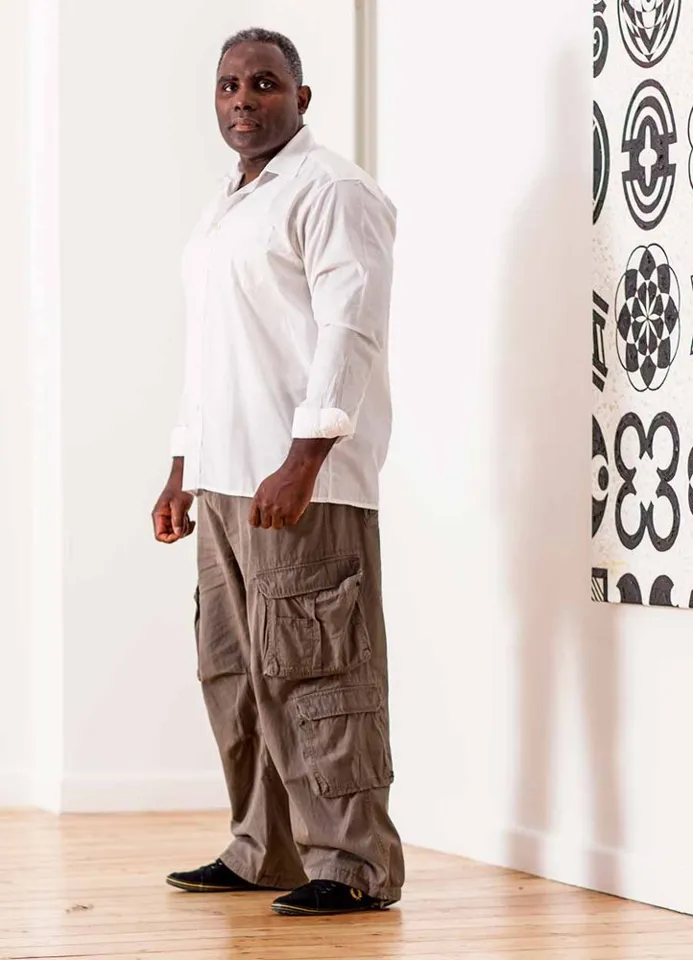
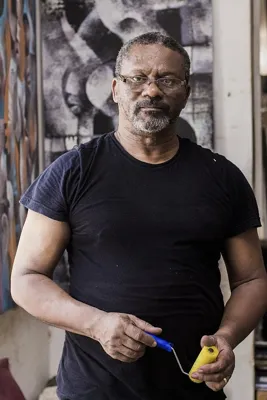
 Photo: octobergallery.co.uk
- Identity confirmed
- Date of birth checked
- Career history reviewed
- Awards & achievements audited
Owusu-Ankomah
Painter
About Owusu-Ankomah
Owusu-Ankomah was a Ghanaian painter and one of the best-known contemporary African artists. His large canvases set human figures among dense fields of symbols, above all the Adinkra signs of the Akan, alongside Chinese ideograms and other scripts, and explore identity, the body and consciousness.
Early life and training
He was born on 24 October 1956 in Sekondi and studied at Ghanatta College of Art in Accra from 1971 to 1974.
Career
From 1979 he travelled to Europe to meet artists and galleries, and in 1986 he settled in Bremen, Germany, where he lived for the rest of his life. He reinterpreted Adinkra symbols for the gallery while keeping much of their original meaning, and his paintings, many in black and white, drew on the Renaissance and ancient writing as well as sacred geometry. Between 2004 and 2008 he withdrew to reflect and study, and emerged with what he called the Microcron, a "symbol of symbols" with its own philosophy, which shaped his later, more colourful work shown in the exhibition Microcron Begins.
Death
He died on 6 February 2025, aged 68.
Frequently asked questions about Owusu-Ankomah
How old was Owusu-Ankomah at death?
Owusu-Ankomah died on February 6, 2025, aged 68. Owusu-Ankomah was born on October 24, 1956.
What was Owusu-Ankomah known for?
Owusu-Ankomah was a Painter.
What was Owusu-Ankomah's nationality?
Owusu-Ankomah was Ghanaian.
Where did Owusu-Ankomah study?
Owusu-Ankomah studied at Ghanatta College of Art, Accra (1971 to 1974).
Personal Information
- Date of Birth
- 24 October 1956
- Date of Death
- 6 February 2025
- Nationality
- Ghanaian
- Region
- Western
Education
- Ghanatta College of Art
- Accra (1971 to 1974)
Related Personalities
Compare Owusu-Ankomah
Sources & References
- "Owusu-Ankomah". Wikipedia.
- "Wikidata entry Q3887749". Wikidata.
Profile compiled from publicly available records. See our full source methodology →